
The first quarter of 2026 has been a watershed moment for the Sunshine State. For real estate professionals operating in Tampa, Miami, Orlando, and Tallahassee, the landscape is shifting from post-pandemic recovery into a highly regulated, yet development-friendly era. Understanding the nuances of Florida real estate laws 2026 is no longer just a “nice to have” — it is the foundation of a safe and profitable practice.
Navigating these changes requires more than just tracking MLS updates. It requires a mechanical understanding of how new legislation affects your daily workflow, your risk exposure, and your clients’ bottom line.
Zoning Reform: Empowering Development (HB 399 & 803)
On March 27, 2026, Governor Ron DeSantis signed HB 399, marking a significant pivot in land-use authority. For years, local governments held substantial power to delay or block developments through subjective zoning hurdles. This new law effectively rebalances that power.
The End of Arbitrary Delays
Under HB 399, municipalities must now provide objective, data-driven justifications for any project denials. Furthermore, the bill mandates that development fees must directly reflect the actual costs of project review, preventing cities from using “impact fees” as a general revenue tool.
Accelerating the Permit Pipeline with HB 803
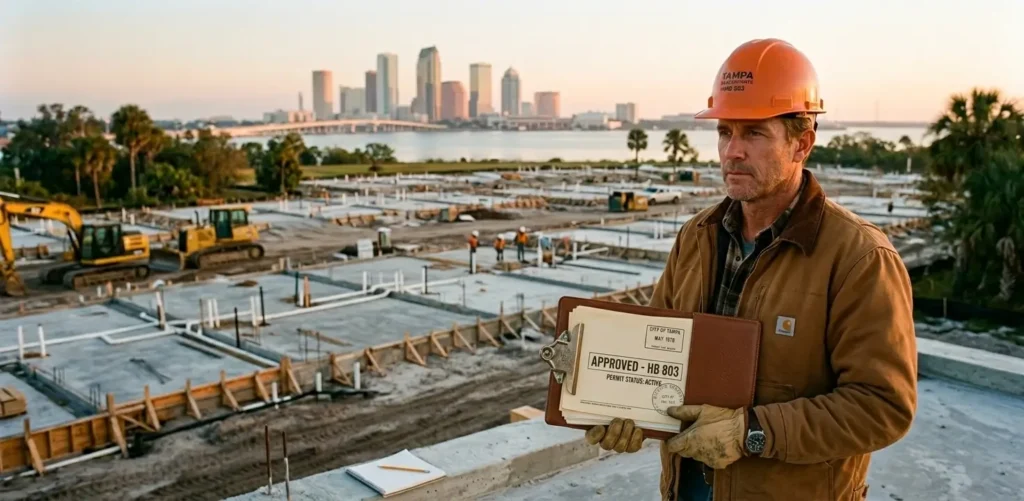
While HB 399 fixes the “why” of development, HB 803 fixes the “when.” This bill establishes a mandatory one-year expiration for single-family home permits, ensuring that projects cannot languish in administrative limbo. It also expands the role of private providers in the inspection process, allowing builders to bypass backlogged municipal inspectors in high-growth areas.
Who Is Affected?
- Builders: You now have a predictable timeline for your ROI.
- Listing Agents: You can expect a more consistent flow of new construction inventory as the “permitting purgatory” fades.
The Property Tax “Fact-Check”: Debunking HJR 203 Rumors
If you follow Florida real estate news on social media, you likely encountered headlines claiming the “total elimination of property taxes.” To maintain your authority as a trusted advisor, you must distinguish between legislative proposals and actual Florida real estate laws 2026.
During the 2026 session, the House passed HJR 203, which proposed a ten-year phase-out of all non-school property taxes. It was a bold move that generated national headlines. However, the measure failed to clear the Senate before the session concluded on March 13, 2026.
Stability Over Revolution
For 2026, the tax structure remains intact. The “Save Our Homes” 3% cap continues to be the primary shield for Florida residents against rising property assessments. Disregard the “tax-free” hype for now. Clients should continue to budget based on current millage rates and ensure they file their Homestead Exemptions on time. Stability is often better for a market than sudden, unpredictable radical changes.
Federal Update: The FinCEN Transparency Ruling
The most volatile news of the quarter concerns federal transparency mandates. On March 1, 2026, new FinCEN reporting requirements officially took effect, targeting non-financed (all-cash) residential transfers to entities like LLCs or trusts. This was a massive shift for the Florida real estate laws 2026 landscape, aiming to pull back the curtain on “shadow” buyers in luxury hubs like Miami and Palm Beach.

The Sudden Legal Shift
However, in a major turn of events, a federal court vacated this rule on March 19, 2026 (Flowers Title Companies, LLC v. Bessent). The court ruled that FinCEN exceeded its statutory authority, effectively setting the reporting requirement aside nationwide.
What this means for you right now?
As of April 2026, reporting persons are not currently required to file these reports with FinCEN. While the official FinCEN website confirms that no liability will attach during this court-ordered pause, professionals must remain vigilant. The federal government is widely expected to appeal, meaning the “anonymity” of corporate cash deals is still under intense legal scrutiny.
Q1 Market Trends: Inventory & Insurance Relief
Q1 2026 has provided a rare glimpse of a stabilizing market. In January, Florida recorded its highest number of new listings since 2008. This surge in inventory is finally giving buyers the leverage they have lacked for nearly two decades.
The Insurance Stabilization
Perhaps the most optimistic news for the Southwest Florida coast is the cooling of the insurance crisis. In March, the Florida Office of Insurance Regulation reported that several new carriers have entered the state market. Increased competition, coupled with a decrease in litigation, is finally slowing the rate of premium increases. For some homeowners in Sarasota and Port Charlotte, we are even seeing modest rate decreases.
Conclusion: Mastering the 2026 Landscape with Closenex
The shifts in Q1 2026 prove that the Florida real estate market is becoming more professionalized — and more litigious. The “solo agent” model is being tested by the combined weight of these evolving Florida real estate laws 2026. From tracking the status of FinCEN appeals to ensuring your listings comply with HB 399 disclosure standards, the administrative burden is now a strategic risk.
Compressed lender timelines, new insurance binding windows, and judicial traps around construction liens — we first flagged these shifts back in late 2025. They haven’t gone away. They’ve intensified. Our September 2025 market briefing walked through exactly how these forces began reshaping Florida transactions, and why a dedicated TC services layer stopped being optional.

To thrive in this environment, you must shift your focus from “doing the work” to “leading the business.” This is the Closenex advantage. We act as your compliance filter, ensuring that every transaction — from pre-listing accuracy to the final contact-to-close documentation — meets the highest professional standards.
By delegating the administrative complexities to a trusted teammate, you secure your place as a market leader. Protect your commissions, safeguard your reputation, and let us handle the red tape. Don’t let changing regulations slow your momentum. Contact us today and let’s ensure your 2026 transactions are flawless.